A missing anterior tooth rarely waits for the treatment plan. Implants need time to integrate, extraction sites need time to heal, and many patients need time to plan the cost of a definitive restoration. In that gap, the Essix retainer with tooth has become one of the most practical tools in restorative and orthodontic practice. It is a clear, vacuum-formed retainer with an acrylic pontic that fills the space, keeps neighboring teeth in position and restores the smile, often within days.
This guide uses the latest available data (2023–2026) to cover where an Essix retainer with a pontic fits clinically, the benefits and limits dentists should weigh, how it compares with flippers and other interim options, current cost data, and what your dental lab needs to deliver a precise, esthetic appliance.
Key Takeaways
An Essix retainer with tooth is a clear thermoplastic retainer with one or more acrylic pontics, used as a short-term, removable provisional.
Common uses include implant healing, post-extraction healing, congenitally missing teeth in growing patients and post-orthodontic space maintenance.
Clear plastic retainers are now the default: 91.1% of orthodontists in a 2024 survey use them.
The 2023 Cochrane review found clear and Hawley retainers similarly stable, though the evidence is low certainty.
2026 data put typical US patient fees for clear retainers at $350–$650, while one published lab example lists $109 for a one-tooth Essix retainer.
15.2% US adults 65+ with no natural teeth (CDC, 2024 report)
91.1% Orthodontists who use clear plastic retainers (2024 survey)
66.7% Vacuum-formed retainer wearers who were compliant (2023 study)
$109 Example lab fee for a one-tooth Essix retainer (2026)
What Is an Essix Retainer with Tooth?
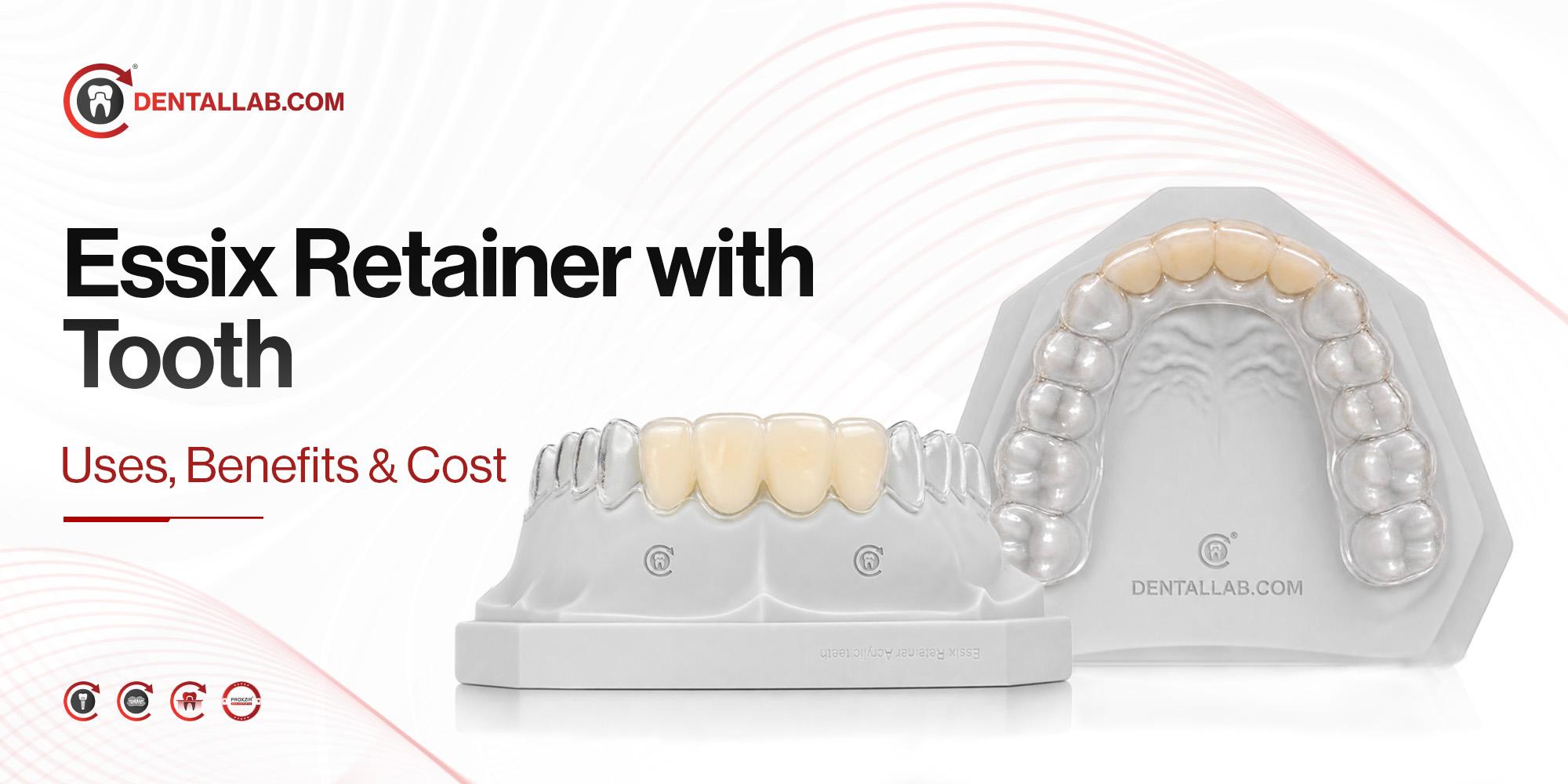
An Essix retainer is a thin, clear, removable retainer made by vacuum- or pressure-forming a thermoplastic sheet over a model of the patient’s arch. An Essix retainer with tooth, also called an Essix retainer with pontic or a clear retainer with a fake tooth, adds an artificial tooth into the edentulous space. Dentallab.com offers a range of Essix retainers and other removable appliances designed to support different orthodontic and restorative requirements.
The lab sets a shade-matched acrylic denture tooth on the model, then forms the thermoplastic shell over it so the pontic is captured inside the retainer. The finished appliance is designed to sit over the edentulous space while helping maintain the position and alignment of adjacent teeth.
The result is a wire-free, nearly invisible appliance that patients can snap in and out. It covers the teeth on either side of the gap, so retention comes from the shell gripping natural tooth contours rather than from clasps or a palatal plate.
Figure 1. How orthodontists prescribe clear retainers
The Essix with pontic is versatile because it does three jobs at once: it replaces the tooth esthetically, it maintains the space, and it stabilizes adjacent and opposing teeth.
1. Provisional During Implant Healing
This is the most frequent use. After implant placement, bone needs time to integrate before the final restoration. The Cleveland Clinic’s guide to dental implants (updated June 2026) notes that osseointegration can take three to nine months, and that patients with front-tooth implants typically receive a temporary tooth while they heal.
“…can take anywhere from three to nine months.”
— Cleveland Clinic, Dental Implants, on implant healing, 2026
An Essix retainer allows the pontic to be relieved or shortened so it hovers over the site without pressing on the healing tissue or the implant. Minimal pressure on the implant site is an important design consideration when soft-tissue healing is the priority.
2. After Extractions and Grafting
When an anterior tooth is extracted, with or without ridge preservation, an Essix retainer with tooth gives the patient an immediate esthetic solution. The pontic’s ridge-lap area can be adjusted chairside so it doesn’t compress a graft or collapse emerging papillae.
3. Congenitally Missing Teeth in Younger Patients
Hypodontia remains a common reason for interim tooth replacement. A recent systematic review and meta-analysis of Iranian studies, with searches through December 2025, reported a pooled hypodontia prevalence of 6.0% across 17 studies. A 2025 radiographic study of 5,075 patients in The Open Dentistry Journal found hypodontia in 7.8%, with maxillary lateral incisors the most frequently affected teeth (47.3% of findings).
Figure 2. Most commonly missing teeth among patients with hypodontia
4. Post-Orthodontic Retention with Space Maintenance
When orthodontic treatment opens space for a future implant or bridge, the retainer must hold both the alignment and the gap. An Essix with pontic does both while giving the patient a complete smile from debond day.
5. Transitional Phases and Treatment Staging
An Essix retainer with pontic can also provide esthetic replacement during crown lengthening or surgical staging, as well as space maintenance while a patient decides between implants and bridges or arranges financing.
6. Older Adults Facing Tooth Loss
Figure 3. Complete tooth loss among US adults aged 65 and older
Esthetics: clear, thin and wire-free, with a shade-matched pontic that blends into the smile.
Protects the healing site: the pontic can be designed to sit passively, keeping load off grafts and implants.
Space and position control: full coverage of adjacent teeth helps prevent drifting, tipping and supraeruption.
Fast and economical: a simple model, a pontic and a thermoformed shell. Turnaround depends on the laboratory and case requirements.
Easy to remake: if the appliance is lost or cracked, a new one can be formed from the stored scan.
Speech and comfort: in a 2023 BDJ Open study, only 11.7% of vacuum-formed retainer wearers cited speech difficulty as a reason for not wearing their retainer, compared with 32.7% of Hawley wearers.
Digital-ready: intraoral scans can be sent directly, and models can be 3D printed for forming.
Limitations and When to Choose Something Else
The same thin shell that makes the Essix esthetic also limits it. Dentists should weigh these trade-offs:
Not for chewing: patients should remove the appliance to eat, and the pontic is not designed to function under heavy load.
Wear and fracture: Essix retainers can be prone to wear, warping and fracture with extended use or parafunction.
Failure risk: the 2023 Cochrane review found Hawley retainers had a lower risk of failure than clear plastic retainers in one trial (risk ratio 0.60), although the evidence was very low certainty.
Occlusal coverage: full occlusal coverage can slightly alter the bite while the appliance is worn.
Long spans and posterior cases: multiple missing teeth, distal extensions or heavy occlusion are usually better served by an interim partial or fixed provisional.
Compliance: results depend on wear. Forgetfulness was cited by 19.0% of vacuum-formed retainer wearers in the 2023 BDJ Open study.
Essix with Tooth vs. Other Temporary Options
Option
Esthetics
Load on Healing Site
Chewing Function
Typical Duration
Best For
Essix retainer with tooth
High, clear and wire-free
Minimal if relieved
Limited; remove to eat
Short-term
Single anterior teeth, implant healing
Acrylic flipper
Good; pink acrylic visible
Can impinge if not relieved
Better support
Short to medium term
Longer healing, staged treatment
Interim partial denture
Moderate; clasps may show
Tissue-borne
Moderate
Medium term
Multiple missing teeth
Hawley with pontic
Moderate; visible wire
Minimal if relieved
Limited
Medium term
Retention plus space maintenance
Fixed provisional
High
Depends on design
Good
Short to medium term
When removability is undesirable
Glidewell’s 2025 clinical comparison sums up the key distinction: Essix retainers and flippers “are not interchangeable.” The flipper offers more functional support for longer timelines, while the Essix wins on esthetics and on protecting the surgical site.
What the Latest Research Says About Clear Retainers
Research published since 2023 focuses on clear retainers in orthodontic retention rather than on pontics specifically, but it remains useful when choosing between Essix-style and Hawley designs.
Stability: the 2023 Cochrane review (47 trials, 4,377 participants) found similar stability for clear plastic and Hawley retainers, with a mean difference in Little’s Irregularity Index of just 0.01 mm. The authors rated the evidence low to very low certainty and could not recommend one retention approach over another.
Comfort: in the same review, Hawley retainers were less comfortable than clear plastic retainers at six months.
Compliance and satisfaction: a 2023 survey of 307 patients in BDJ Open found 66.7% of vacuum-formed retainer wearers were compliant. Satisfaction was identical for both types (3.7 out of 5).
Prescribing trends: the 2024 Angle Orthodontist survey found 79.1% of orthodontists give only one set of clear retainers at debond. That matters for interim pontic retainers, which are often worn daily for months.
Figure 4. Reasons for not wearing retainers, Hawley vs. vacuum-formed
Digital fabrication is also evolving. A 2024 clinical status report in the Journal of Clinical Orthodontics on direct-printed aligners describes promising accuracy, but stresses strict manufacturing protocols as clinical evidence accumulates. For now, thermoforming over a printed or stone model remains the standard approach for Essix retainers with pontics.
How Much Does an Essix Retainer with Tooth Cost?
Fees vary widely by practice, region, number of pontics and whether a new scan is needed. Here is what current published data show.
Patient Fees
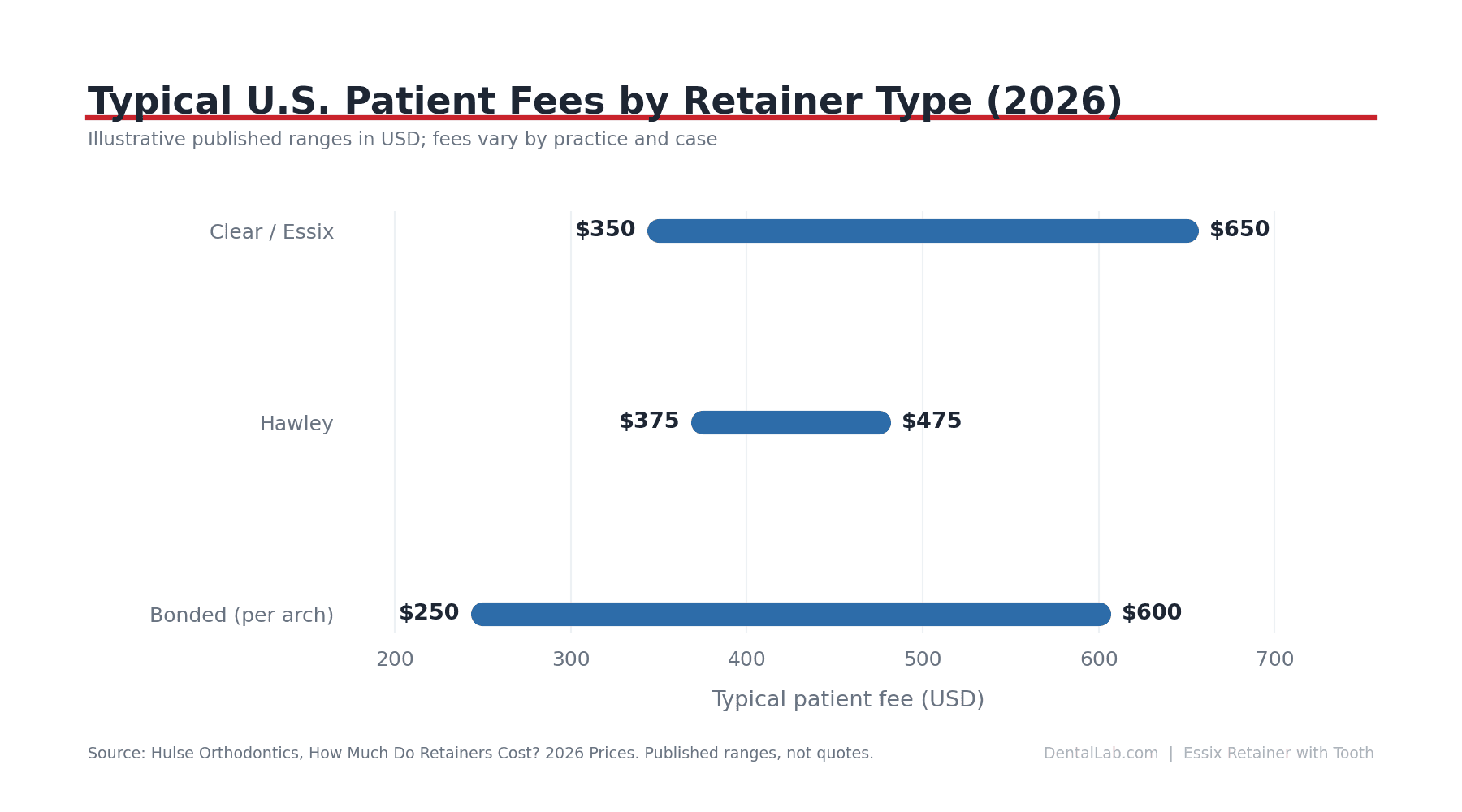
Hulse Orthodontics’ 2026 retainer cost guide (updated October 2026) lists typical US patient fees of $350–$650 for clear or Essix retainers, $375–$475 for Hawley retainers and $250–$600 per arch for bonded retainers. Colgate, citing the ADA, gives a lower range of $100–$250 for an Essix retainer. Retainers with a pontic generally cost more than a standard clear retainer because of the added tooth, shade matching and chairside adjustment.
Figure 5. Typical US patient fee ranges by retainer type, 2026
For practices, the lab fee is a small part of the total. One published lab price example lists an Essix retainer at $109 for one tooth and $18 for each additional tooth, excluding shipping and taxes, with a 4-day in-lab time and a one-month limited warranty. Pricing at other labs varies, so compare fee schedules, remake policies and turnaround.
Figure 6. Example lab fee for an Essix retainer by number of pontics
Source: Calculated from a published pricing example ($109 first tooth, $18 each additional), viewed November 2026. Illustrative only.
What Drives the Cost
Cost Factor
Why It Matters
Number of pontics
Each additional tooth adds lab time and materials.
Scan or impression
A new scan or impression costs more than remaking from a stored file.
Material and thickness
Thicker or premium sheets and higher-grade denture teeth add cost.
Shade and esthetic work
Custom shading or characterization of the pontic increases lab time.
Chairside time
Delivery, pontic relief over the surgical site and follow-up adjustments.
Replacements
Lost or cracked appliances are usually charged at the full fee.
Insurance coverage for interim appliances varies, and Hulse notes that replacements are usually not covered, although FSA, HSA or HRA funds can often be used. Building the provisional into the implant or orthodontic treatment fee is a common way to make costs predictable for patients.
How Labs Fabricate an Essix Retainer with Tooth
Records: the dentist sends an intraoral scan or impression of the arch, ideally after extraction or surgery so the model reflects the current ridge.
Model: the lab pours a stone model or 3D prints a model from the digital file.
Pontic selection and setup: the technician selects a denture tooth by shade and mould, then shapes and positions it with appropriate ridge relief.
Blockout: undercuts are managed so the retainer seats easily without being overly retentive.
Thermoforming: a thermoplastic sheet (1 mm is the most commonly used thickness, per the 2024 survey) is heated and formed over the model, capturing the pontic.
Trimming and finishing: margins are trimmed for comfort and retention, and edges are polished.
Quality check: the lab verifies seating, pontic position, shade and smooth margins before shipping.
Prescription Checklist for a Better Fit
Include in the Rx
Why
Tooth number(s) to replace
Avoids errors in pontic placement.
Shade and mould preference
Matches adjacent teeth for a natural result.
Pontic contact with tissue
For example, light contact, relief or ovate shaping.
Surgical site notes
Implant, graft or extraction date, so the lab can relieve the site.
Arch coverage
Full arch or limited segment, depending on retention and comfort.
Opposing model and bite
Helps the lab check clearance and occlusion.
Photos
Smile and retracted photos improve shade and esthetics.
Care Guidance to Share with Patients
Simple instructions extend the life of the appliance and protect oral health. Based on guidance published by Colgate (citing the ADA), practices commonly advise patients to:
Remove the retainer to eat and drink anything other than water.
Rinse in cool water and brush gently with a non-abrasive toothpaste after meals, then store it in its case.
Keep it away from hot water and other heat sources, which can warp the plastic.
Avoid biting or chewing on the pontic.
Report cracks, rough edges or changes in fit promptly, so the practice can decide whether a remake is needed.
Keep regular checkups while the definitive treatment progresses.
Frequently Asked Questions
What is an Essix retainer with tooth?
It is a clear, vacuum-formed thermoplastic retainer that holds one or more acrylic pontics to replace missing teeth temporarily and maintain space.
How long can a patient wear an Essix retainer with a pontic?
It is designed as a short-term provisional for the healing or planning period before a definitive restoration. Longer timelines, heavy function or parafunction usually call for a flipper, interim partial or fixed provisional.
Can patients eat with an Essix retainer with tooth?
It should be removed for meals. The pontic and shell are not designed for chewing forces.
Is an Essix retainer better than a flipper?
Not in every case. The Essix offers superior esthetics and can avoid loading the healing site, while a flipper provides more functional support for longer timelines.
How much does an Essix retainer with tooth cost?
2026 data put typical patient fees for clear retainers at about $350 to $650, with an ADA-cited range of $100–$250 for a basic Essix. Lab fees are much lower; one major lab lists $109 for a one-tooth Essix retainer.
Are clear retainers as effective as Hawley retainers?
The 2023 Cochrane review found similar stability for clear plastic and Hawley retainers, though the evidence is low certainty. Clear retainers were more comfortable, while Hawley retainers had a lower failure risk in one trial.
Can it be made from an intraoral scan?
Yes. Labs can print a model from the scan and thermoform the retainer over it, and the stored file makes remakes easy.
Partner with Dentallab.com for Essix Retainers and Provisionals
A provisional is often the first restoration a patient sees, and it shapes their confidence in the whole treatment plan. Dentallab.com’s retainer range includes Essix retainers and stay plates alongside Hawley and clear retainers, plus a full line of implant, fixed and removable restorations for the definitive phase.
Dentists can send cases digitally from most major intraoral scanners or request a pickup for traditional impressions, from the lab’s Fort Lauderdale, Florida and Maspeth, New York locations. New accounts have no minimums, and the first case comes with a $150 lab credit.