A patient missing one tooth and a patient missing an entire arch may both need dental implant restorations, but the laboratory requirements behind their treatment are very different.
One case may involve a single implant crown with a custom abutment. Another may require a multi-unit bridge, a removable implant-retained overdenture, or a fixed full-arch prosthesis supported by several implants.
For dentists, choosing the appropriate restoration is only part of the process. The implant position, prosthetic components, restorative materials, occlusion, and laboratory workflow must all work together.
This guide explains the main types of dental implant restorations, the materials used to fabricate them, and the clinical and laboratory considerations that help support predictable restorative outcomes.
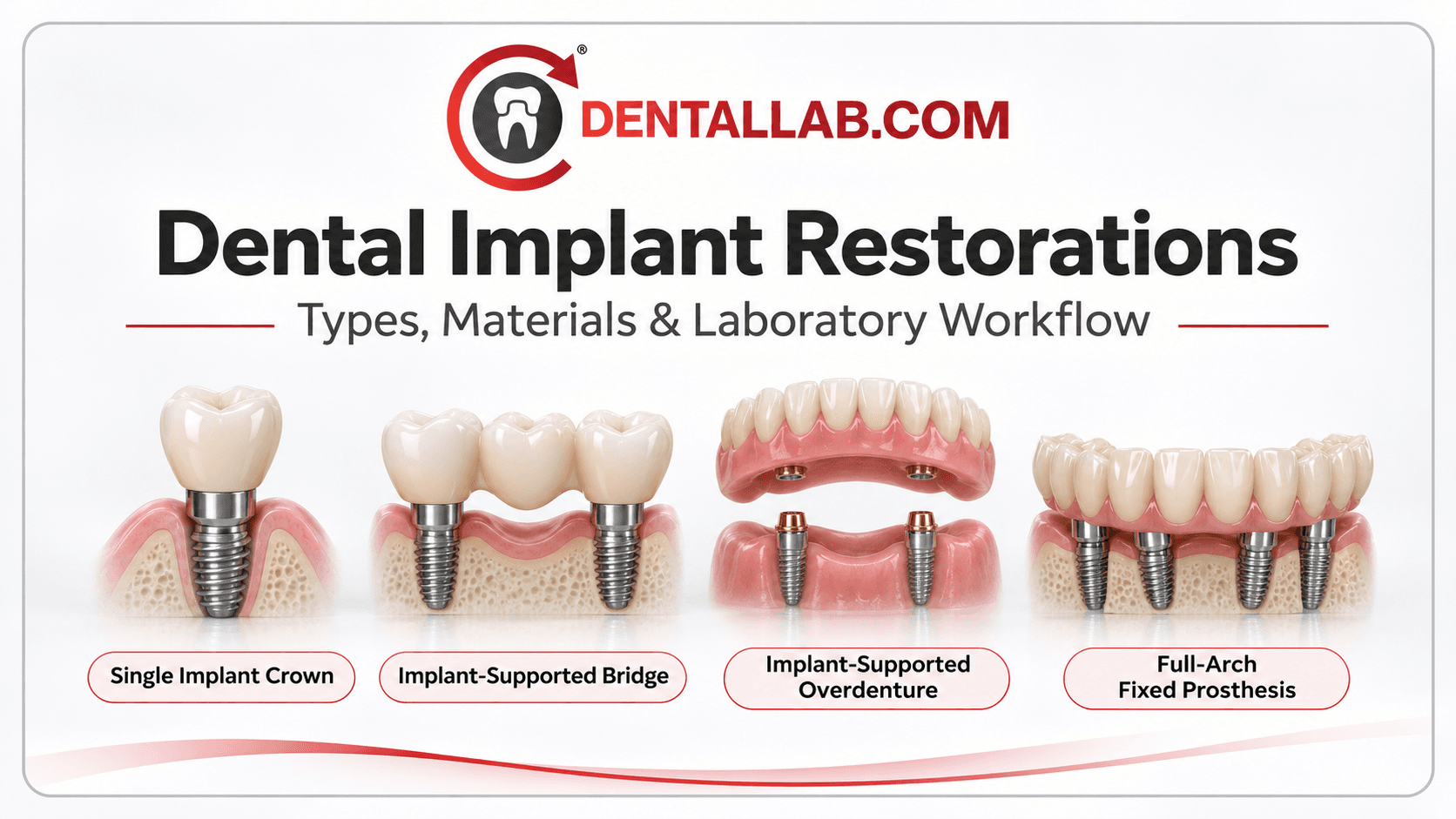
The main types of dental implant restorations used to replace one or more missing teeth.
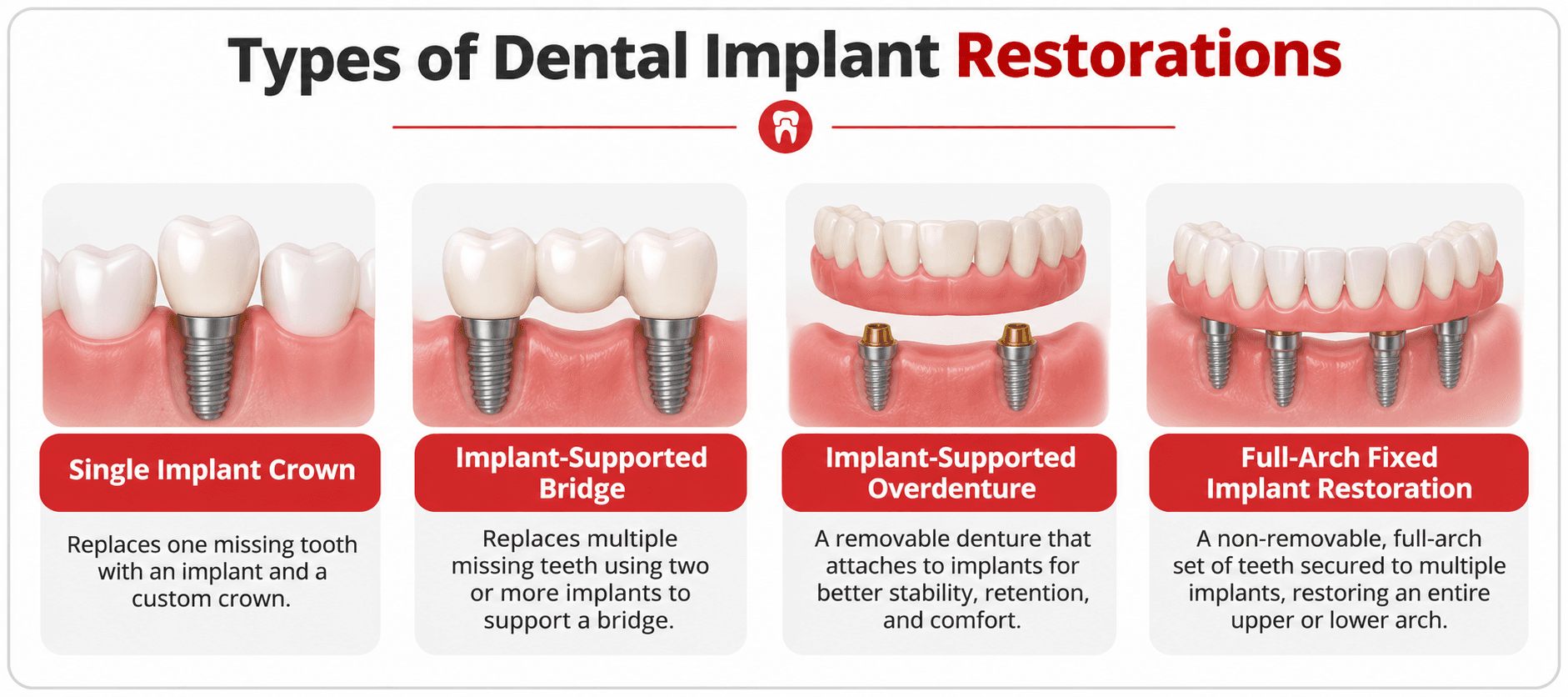
Dental implant restorations can be grouped into four primary categories: single crowns, implant-supported bridges, removable overdentures, and full-arch fixed prostheses. Each addresses a different pattern of tooth loss and has distinct design and fabrication requirements.
Single Implant Crowns
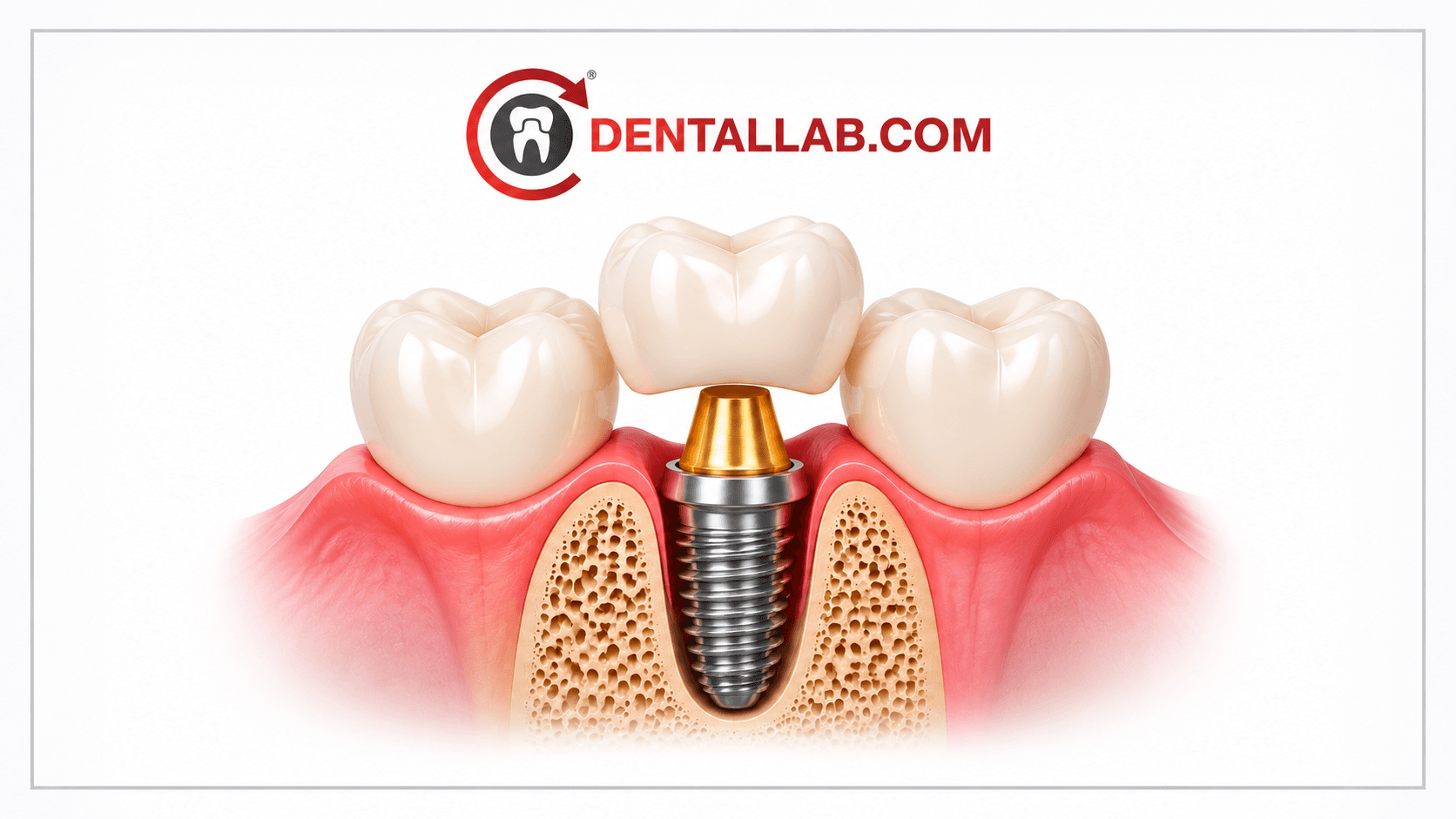
A single implant crown replaces one missing tooth using an individual implant fixture and a prosthetic crown.
The crown may be screw-retained directly to the implant or retained through an intermediate abutment, depending on the implant system and restorative design.
Important laboratory considerations include:
Implant manufacturer and connection type.
Platform and restorative component compatibility.
Screw-access position.
Stock or custom abutment selection.
Crown material and available restorative space.
Proximal contacts, occlusion, and emergence profile.
For posterior restorations, monolithic zirconia may be considered where functional loading is a primary concern. In esthetic areas, multilayered or selectively layered materials may offer additional control over shade and characterization.
Single-unit implant crowns require accurate implant-position records and careful verification of component seating before delivery.
Implant-Supported Bridges
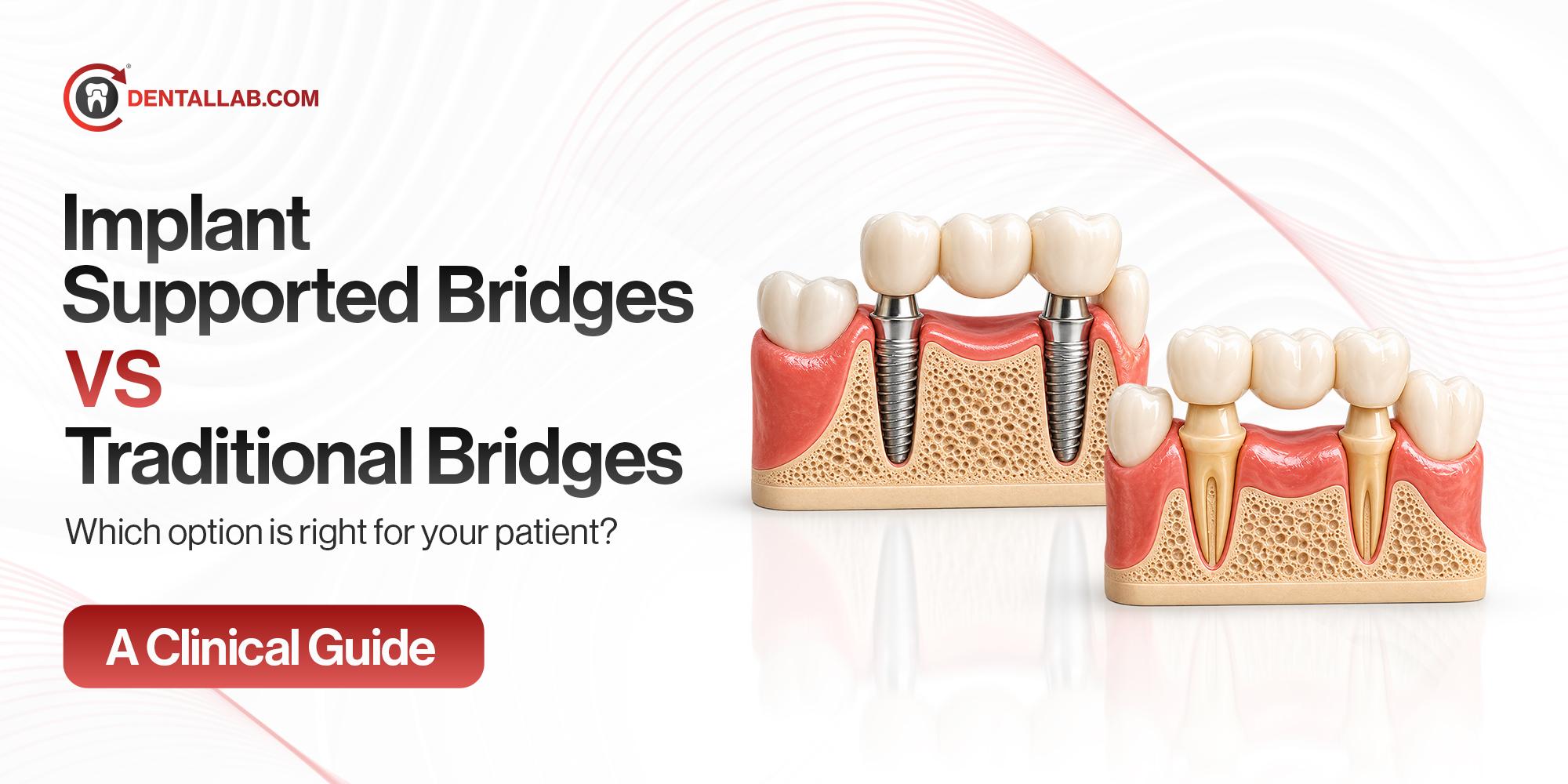
An implant-supported bridge replaces multiple missing teeth using two or more implants as the primary support for a fixed prosthesis.
Unlike a conventional tooth-supported bridge, it does not depend on preparing adjacent natural teeth as retainers.
The laboratory must account for:
Implant position and angulation.
Number and distribution of supporting implants.
Span length and framework design.
Available restorative space.
Occlusal loading.
Hygiene access beneath the prosthesis.
Passive seating across the supporting components.
Multi-unit implant bridges require particular attention to the relationship between the digital or physical implant records and the final framework.
Where appropriate, verification procedures should be selected according to the number of implants, framework design, and clinical circumstances.
Implant-Supported Overdentures
An implant-supported overdenture is a removable prosthesis retained or supported by dental implants.
Common attachment approaches include Locator-type attachments, ball attachments, and bar-retained systems.
These designs can improve retention and stability compared with conventional complete dentures, although the appropriate number of implants and attachment system depends on the patient’s anatomy and treatment plan.
From a laboratory perspective, important considerations include:
Implant and attachment compatibility.
Accurate implant-position records.
Available interarch space.
Denture tooth arrangement.
Acrylic base thickness.
Framework reinforcement where indicated.
Attachment housing position and processing.
Overdentures also require a maintenance plan. Attachment inserts, clips, housings, denture bases, and prosthetic teeth may need periodic service or replacement.
A systematic review of reinforced implant overdentures found that maintenance events, including attachment wear, insert replacement, relining, and prosthesis repairs, remain relevant even when overall implant and prosthesis survival is high.
Full-arch fixed implant restorations replace an entire dental arch using multiple implants and a fixed prosthesis.
All-on-4 is one well-known treatment approach within this category, although full-arch restorations can use different implant numbers and configurations according to the clinical plan.
Common laboratory designs include:
CAD/CAM titanium frameworks with acrylic teeth.
Titanium-supported hybrid prostheses.
Monolithic zirconia full-arch restorations.
Zirconia restorations with customized gingival characterization.
These cases require careful attention to implant distribution, prosthetic space, framework design, screw-access locations, occlusion, and hygiene access.
For complex cases, a verification jig, framework try-in, bite verification, or design approval may be appropriate before definitive fabrication.
Dentallab.com’s NeoSolidZir full-arch solution illustrates how a staged verification and final-delivery workflow can be used for selected zirconia full-arch restorations.
What Every Implant Restoration Needs
Although implant restorations differ in design, several requirements apply across the major categories.
Verified Implant Position
The laboratory must receive an accurate record of implant position and orientation.
For digital cases, this commonly involves a compatible scan body and the correct digital library. For conventional cases, appropriate impression copings and verified impression techniques are used.
A scan body that is not completely seated, or an incorrectly identified implant library, can compromise the accuracy of the resulting design.
For multi-implant restorations, capturing the spatial relationship between implants is especially important.
Compatible Prosthetic Components
Implant components are not universally interchangeable.
The laboratory needs the implant manufacturer, system, platform, connection type, and any relevant restorative component information.
This helps avoid errors involving incompatible screws, abutments, titanium bases, or implant analogs.
When the information is incomplete, the laboratory should request clarification before proceeding with definitive fabrication.
Fit, Emergence Profile and Occlusion
The final restoration should be designed around the available soft-tissue contours, restorative space, and functional requirements.
The emergence profile affects how the crown or prosthesis transitions from the implant platform through the surrounding tissue.
Excessive contouring may compromise hygiene access, while insufficient contouring can affect esthetic integration.
Occlusion also requires careful evaluation, particularly in multi-unit and full-arch cases.
Fit verification should be appropriate to the restoration type. A single crown and a full-arch framework do not require identical verification protocols.
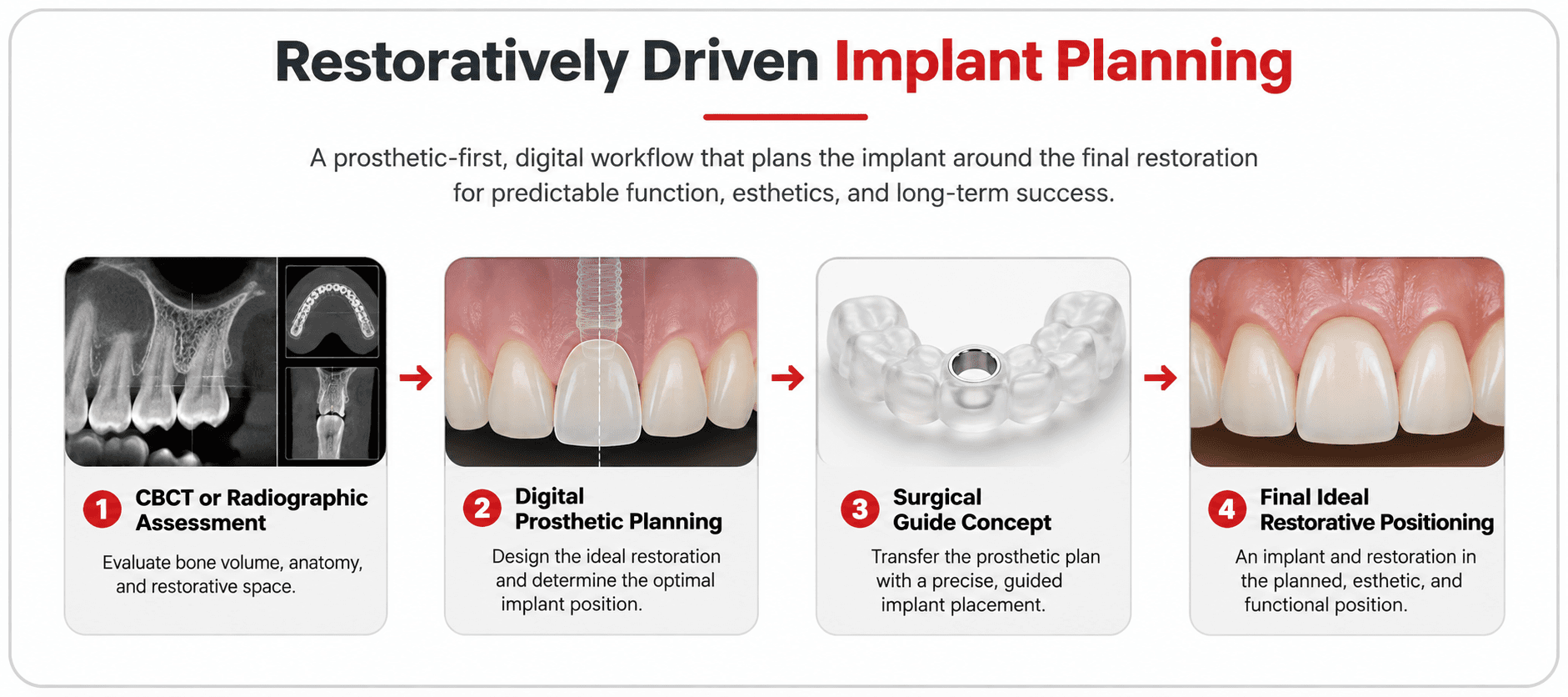
Restoratively Driven Implant Planning
A prosthetic-first implant planning workflow linking diagnosis, digital planning, surgical guidance, and final restorative positioning.
Successful implant restoration begins with the intended final prosthesis, not simply the location where an implant can be placed.
Restoratively driven planning considers the ideal tooth position, available bone, tissue contours, occlusion, and the prosthetic components required to deliver the final restoration.
Where indicated, the treatment team may use CBCT data, intraoral scans, diagnostic wax-ups, and surgical guides to coordinate implant placement with the restorative plan.
This approach can help determine:
Appropriate implant position and angulation.
Screw-access location.
Available restorative space.
Emergence-profile requirements.
Abutment and framework design.
Esthetic and functional considerations.
The surgeon, restorative dentist, and laboratory should communicate about these requirements before complex cases progress to definitive fabrication.
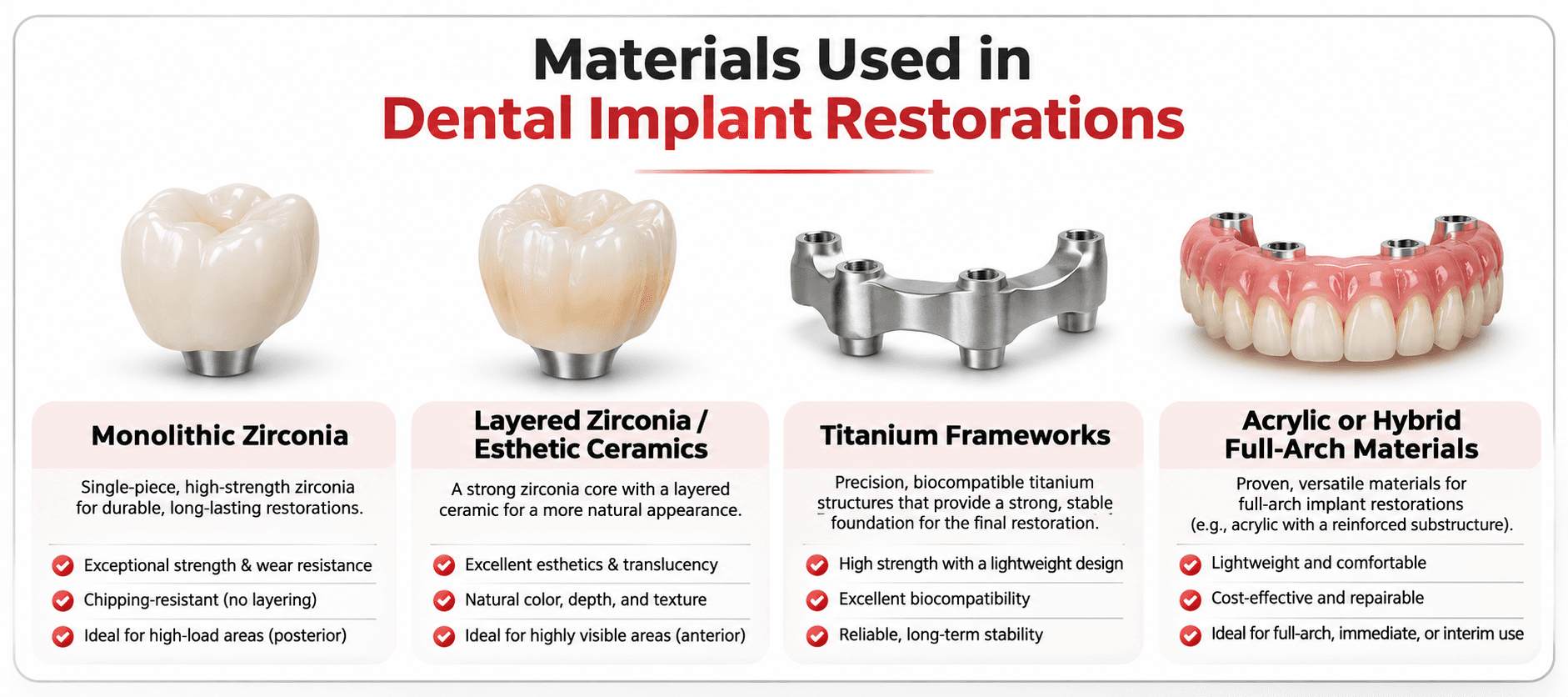
Materials Used in Dental Implant Restorations
Common material options for implant crowns, bridges, and full-arch implant prostheses.
Material selection depends on restoration type, tooth position, occlusal loading, available restorative space, esthetic requirements, and the design of the prosthesis.
Monolithic Zirconia
Monolithic zirconia is commonly considered for posterior implant crowns and selected multi-unit restorations where strength and resistance to veneer-related chipping are important.
Dentallab.com’s ProXzir zirconia system includes full-strength monolithic zirconia rated at 1,400 MPa, alongside multilayered and porcelain-characterized options.
Its suitability depends on the case, material thickness, connector design, occlusal conditions, and manufacturer requirements.
Layered Zirconia and Esthetic Ceramics
Layered zirconia combines a zirconia framework with veneering porcelain to provide additional shade and surface characterization.
Lithium disilicate and other esthetic ceramics may also be considered for selected implant-supported applications when the restorative system and clinical requirements support their use.
The final material decision should account for both esthetic objectives and mechanical demands.
Dentists can review Dentallab.com’s restorative material options when planning material selection for their cases.
Titanium Frameworks and Hybrid Materials
Titanium frameworks are frequently used in implant-supported full-arch prostheses, particularly when a rigid substructure is required.
These frameworks may support acrylic teeth, denture materials, or other restorative components.
Zirconia full-arch designs provide another option for selected cases, with different esthetic, mechanical, and maintenance considerations.
The laboratory should evaluate framework dimensions, passive seating, prosthetic space, material thickness, and the intended restorative design before fabrication.
The Dental Laboratory’s Role
An implant restoration is the result of coordinated work between the surgical team, restorative dentist, and dental laboratory.
The laboratory contributes to the process through:
Implant-system and component verification.
Digital scan or impression assessment.
Abutment and framework design.
Material selection support.
CAD/CAM fabrication.
Fit and contour evaluation.
Quality control before delivery.
On complex multi-unit and full-arch cases, communication with the technician responsible for the design can be particularly valuable.
A design preview or verification stage, when appropriate, allows the clinical team to review critical details before definitive fabrication.
Dentallab.com supports implant cases across different restoration types, with digital case submission and laboratory workflows designed around the information required for fabrication.
Digital Implant Restoration Workflow
A digital laboratory workflow from case submission and verification through CAD design, fabrication, and final quality control.
Digital workflows connect clinical records with laboratory design and manufacturing. Their effectiveness depends on accurate scanning, compatible components, and appropriate verification.
Case Submission and Verification
The dental practice submits the required implant information, digital scans or impressions, opposing records, bite registration, and relevant clinical photographs.
The laboratory reviews the case for missing information, implant compatibility, and restorative requirements.
Digital Design and Review
The technician uses the available records and appropriate implant libraries to design the restoration.
For complex cases, a design preview can provide an opportunity to review implant positions, emergence, screw access, and prosthetic contours before fabrication.
Fabrication and Quality Control
Approved designs proceed to milling, printing, component assembly, finishing, and other required laboratory processes.
The completed restoration is checked according to its design and material requirements before delivery.
Dentists can review Dentallab.com’s case submission and laboratory workflow for details about digital submissions, case verification, fabrication, and delivery.
7 Best Practices for More Predictable Implant Restorations
1. Identify the implant system accurately.
Record the manufacturer, platform, connection, and required restorative components before sending the case.
2. Verify scan-body seating.
Confirm that the correct scan body and digital library are being used, with complete seating before scanning.
Consider functional loading, available space, esthetic demands, and material-specific design requirements.
5. Evaluate hygiene access.
Emergence contours and full-arch prosthesis design should allow practical access for patient maintenance.
6. Use appropriate verification procedures.
Select verification jigs, framework try-ins, bite checks, and design approvals according to case complexity.
7. Maintain direct laboratory communication.
Resolve missing information and review complex design details before definitive fabrication rather than waiting until delivery.
What Should Dentists Include in an Implant Restoration Prescription?
A complete implant prescription helps the laboratory understand the clinical requirements before design begins.
Implant information
Implant manufacturer and system.
Platform and connection type.
Implant positions and tooth numbers.
Scan-body or impression-coping identification.
Required abutments, analogs, and screws.
Restorative instructions
Restoration type: crown, bridge, overdenture, or full-arch prosthesis.
Screw-retained, cement-retained, or attachment-based design.
Material preference.
Shade and esthetic instructions.
Occlusal requirements.
Soft-tissue and hygiene considerations.
Supporting records
Intraoral scans or conventional impressions.
Opposing arch records.
Bite registration.
Relevant radiographs and CBCT records when indicated.
Clinical photographs and diagnostic references.
Dentists should clarify any missing implant or component information with the laboratory before definitive design and fabrication.
Frequently Asked Questions
What are the main types of dental implant restorations?
The main categories are single implant crowns, implant-supported bridges, removable implant overdentures, and full-arch fixed implant prostheses. Each is designed for a different pattern of tooth loss and has distinct restorative requirements.
What is the difference between an implant crown and an implant bridge?
An implant crown typically replaces one missing tooth using an individual implant. An implant-supported bridge replaces multiple missing teeth using two or more implants to support a connected prosthesis.
What is an implant-supported overdenture?
An implant-supported overdenture is a removable prosthesis that attaches to dental implants using systems such as Locator, ball, or bar attachments. It provides additional retention and stability compared with a conventional denture.
What is an All-on-4 restoration?
All-on-4 is a full-arch implant treatment approach in which a fixed prosthesis is supported by four strategically placed implants, subject to the clinical treatment plan and implant-system requirements.
Which material is best for implant restorations?
There is no universal best material. Monolithic zirconia may suit selected high-load restorations, layered zirconia can offer additional esthetic characterization, and titanium frameworks are commonly used in full-arch hybrid designs. The final choice depends on the clinical and restorative requirements.
How long does an implant restoration take?
The timeline varies according to the surgical protocol, healing requirements, loading approach, restoration type, and laboratory fabrication schedule. Immediate provisionalization may be appropriate in selected cases, while others require a healing period before definitive restoration. The treating clinician determines the appropriate protocol.
Why is implant position important for the final restoration?
Implant position affects screw-access location, emergence profile, available restorative space, occlusion, and the ability to fabricate a cleansable, esthetic prosthesis.
What information does a dental laboratory need for an implant case?
The laboratory generally needs the implant manufacturer, system, platform, connection, scan-body or impression information, opposing records, bite registration, restoration type, and material and esthetic instructions.
Can a dental laboratory handle both single crowns and full-arch implant restorations?
A full-service implant laboratory may support single-unit crowns, implant bridges, overdentures, and full-arch prostheses. Dentists should verify the laboratory’s capabilities, implant-system compatibility, verification procedures, and experience with the intended restoration.
What should dentists look for in an implant dental laboratory?
Look for accurate component verification, digital workflow capabilities, appropriate fit-verification procedures, material options, experienced technicians, and clear communication throughout the case.
Final Thoughts
Dental implant restorations range from a single crown to a complete fixed or removable arch, but every case depends on accurate clinical records, compatible prosthetic components, thoughtful material selection, and appropriate laboratory verification.
The most effective laboratory partnership begins before fabrication. When the dentist and technician agree on the implant system, restoration design, restorative requirements, and verification process, they can address potential problems earlier in the workflow.
Dentallab.com supports dental practices nationwide with implant restorations, digital case workflows, and a range of restorative materials and full-arch solutions.
Try your first case with us and get $150 OFF. Claim your credit at Dentallab.com.