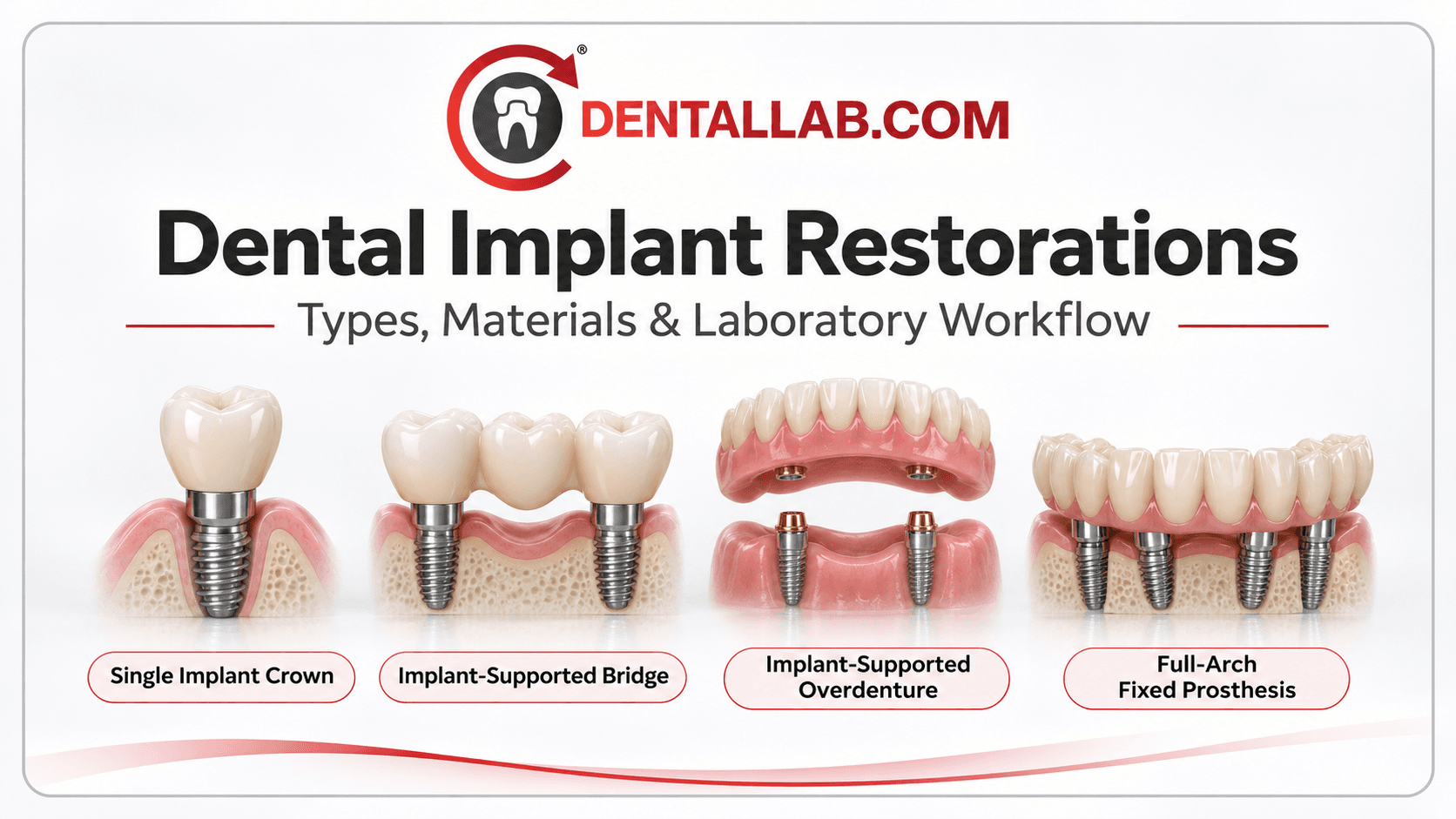
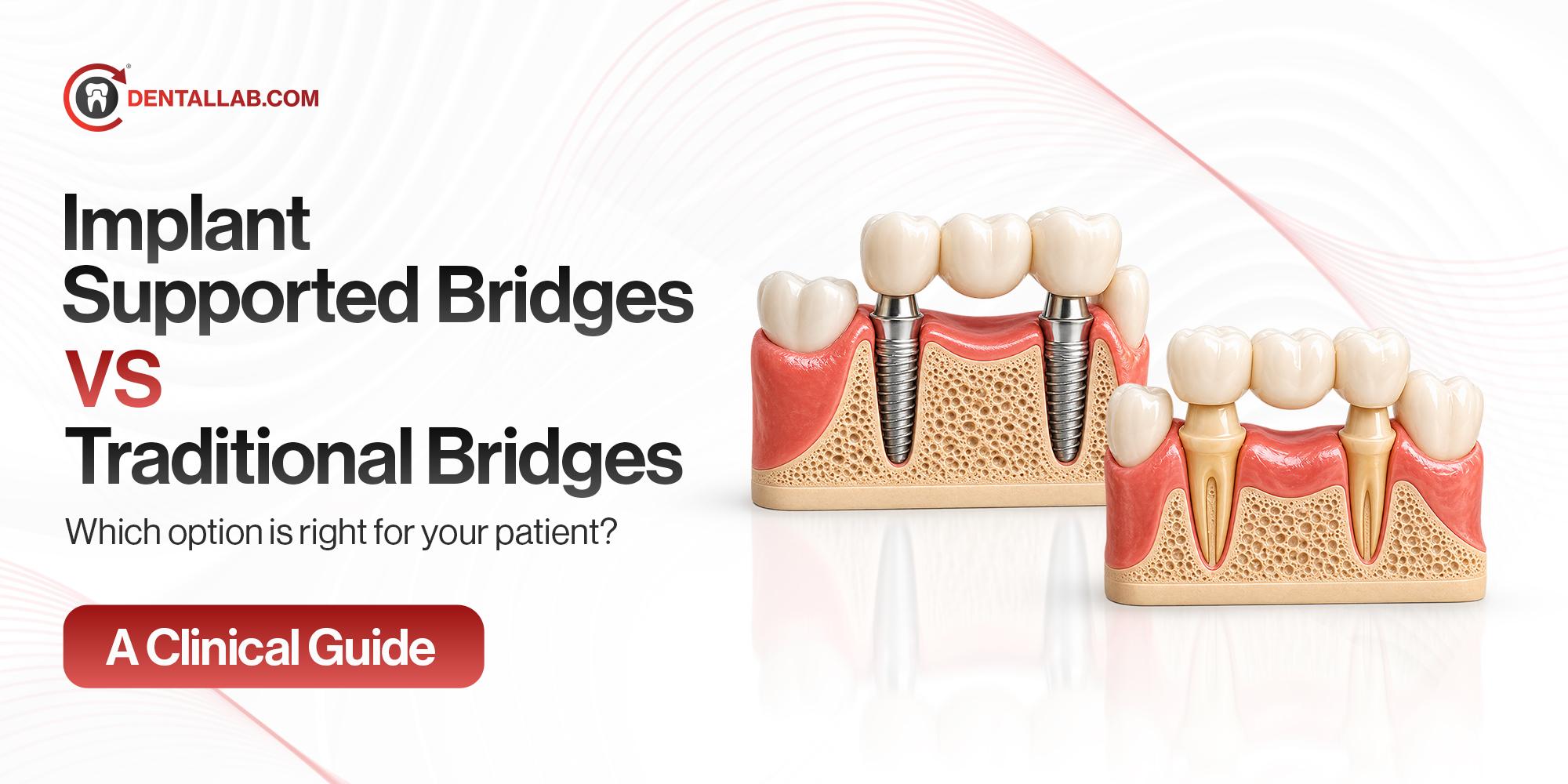
Two implant crowns can look almost identical when viewed from the front of the mouth. Yet one may seat accurately, maintain healthy peri-implant tissue, and remain stable through years of function, while the other develops screw loosening, poor emergence contours, or repeated adjustments.
The difference often begins long before the final crown reaches the dentist’s chair.
Implant crown restorations depend on accurate implant-position records, compatible prosthetic components, appropriate abutment selection, material choice, and precise laboratory fabrication. Unlike a conventional crown supported by a natural tooth, an implant crown connects directly to an engineered implant-abutment interface.
That makes communication between the restorative dentist and dental laboratory especially important.
This guide examines the clinical and laboratory decisions that influence implant crown fit, retention, esthetics, material selection, and long-term maintenance.
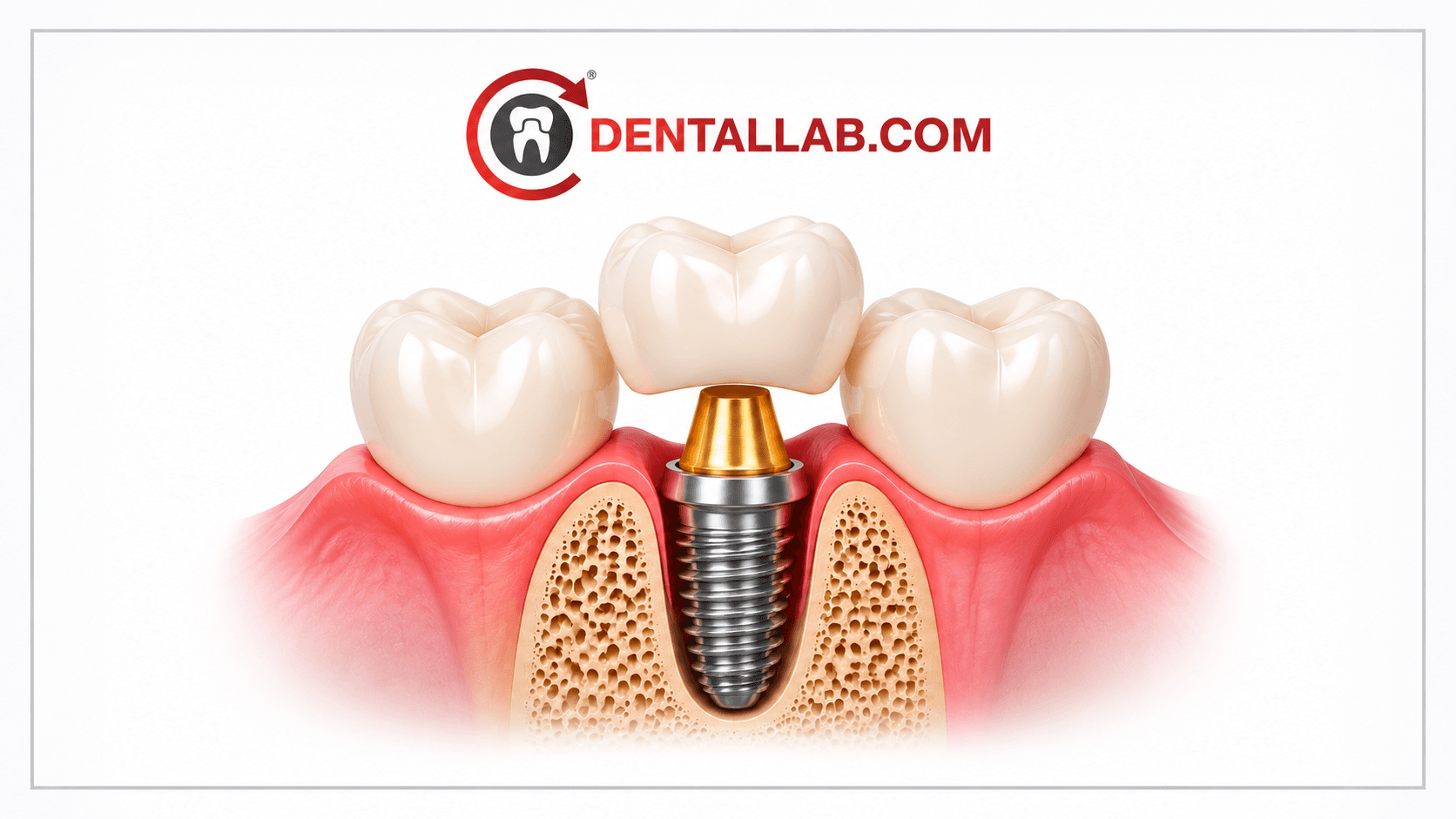
An implant crown is a fixed restoration designed to replace a missing tooth using a dental implant as its foundation.
A typical implant crown system includes three components:
Implant fixture: The surgically placed component that integrates with the surrounding bone.
Abutment: The connection between the implant fixture and the final restoration.
Prosthetic crown: The visible restoration designed to reproduce the tooth’s shape, function, and appearance.
Depending on the restorative system, the crown may connect directly to the implant or be retained through a separate abutment.
The laboratory must know the implant manufacturer, connection type, platform, restorative components, and intended retention method before finalizing the design.
An incorrect or unverified component selection can prevent complete seating and compromise the restoration.
Screw-Retained vs Cement-Retained Implant Crowns
Comparison of two implant crown retention methods: screw-retained and cement-retained restorations.
Retention method is one of the first decisions in implant restorative planning. Both screw-retained and cement-retained crowns have appropriate clinical applications.
The choice depends on implant angulation, access-channel position, esthetic requirements, available restorative space, retrievability, and the ability to control excess cement.
Screw-Retained Implant Crowns
A screw-retained crown connects to the implant or an appropriate restorative component through a prosthetic screw.
The screw access channel is typically located on the occlusal or lingual/palatal surface, depending on implant position and restorative design.
Advantages include:
Retrievability for maintenance and repair.
No intraoral luting cement around the implant margin.
Easier access to the implant-abutment connection.
Simplified management when prosthetic components require replacement.
Potential limitations include:
Screw-access openings may affect occlusal anatomy or esthetics.
Screw loosening can occur.
Implant angulation may produce an unfavorable access-channel position.
Accurate component compatibility and seating are essential.
Cement-Retained Implant Crowns
A cement-retained crown is cemented onto an implant abutment rather than being directly secured through an accessible crown screw channel.
This approach can provide esthetic flexibility when the implant’s angulation makes a screw-access opening undesirable.
Advantages include:
No visible screw-access opening on the crown.
Flexibility in managing certain implant angulations.
Familiar crown-delivery procedures for restorative clinicians.
Potential limitations include:
Residual subgingival cement may contribute to peri-implant inflammation.
Retrieval can be more difficult.
Abutment margin location and cement cleanup require careful planning.
A systematic review comparing screw- and cement-retained implant reconstructions reported similar five-year survival rates, while identifying differences in biological and technical complications. The findings support selecting the retention method according to the clinical situation rather than assuming one approach is universally superior.
Stock abutments are prefabricated components available in predetermined dimensions and configurations.
They may be appropriate when implant position, restorative space, tissue contours, and margin requirements align with the available component.
Common considerations:
Implant compatibility.
Available gingival height.
Margin accessibility.
Restorative clearance.
Emergence contour requirements.
Stock abutments can offer a straightforward and economical option for selected posterior cases.
Custom Abutments
Custom abutments are designed for the individual implant position and restorative requirements.
They can provide greater control over margin location, contour, and emergence profile.
Depending on the case, materials may include titanium, zirconia, or zirconia bonded to a titanium base.
Custom abutments can be particularly useful when tissue contours, implant angulation, or esthetic requirements make a prefabricated component less suitable.
However, custom abutments are not automatically necessary for every implant crown. Selection should reflect the restorative plan and available anatomy.
Implant Crown Materials: Where ProXzir Fits
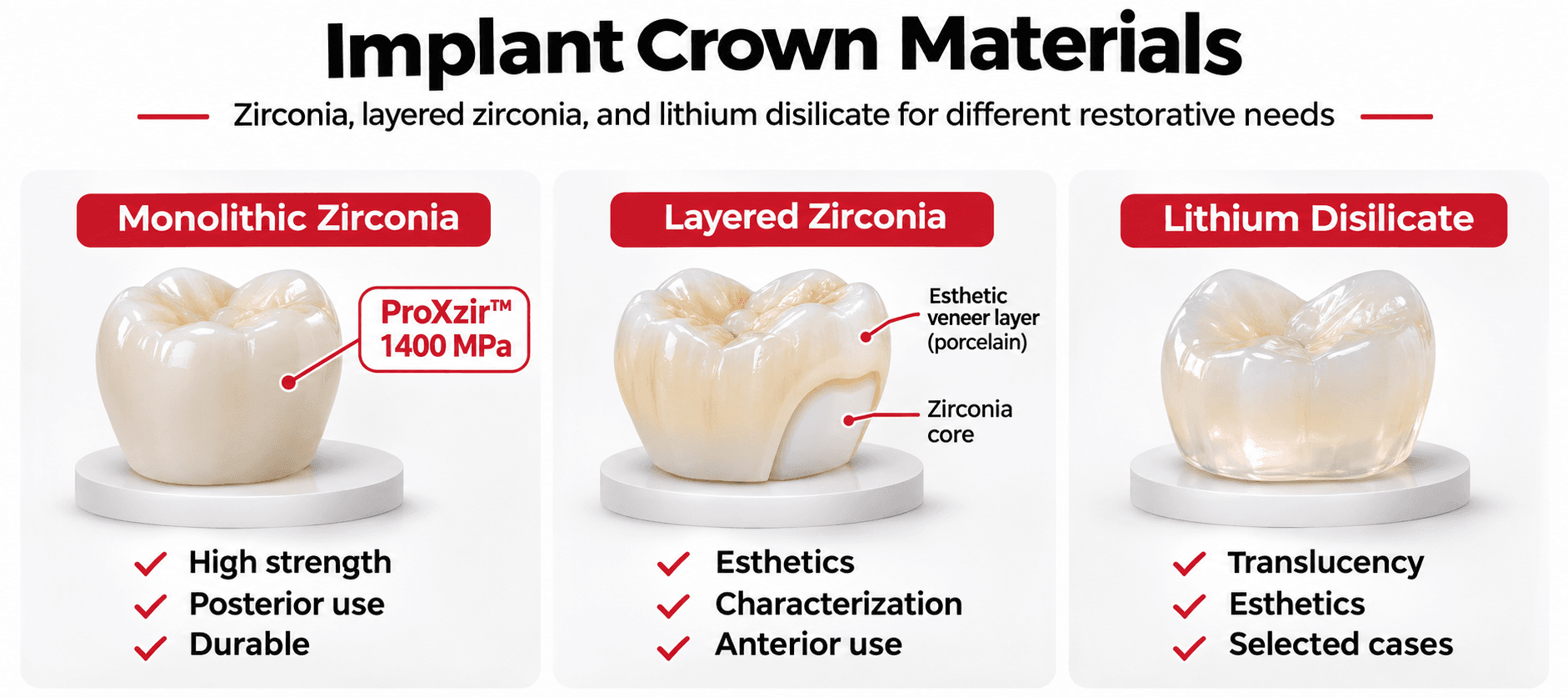
Monolithic zirconia, layered zirconia, and lithium disilicate offer different strength and esthetic characteristics for implant crown restorations.
Material selection should consider tooth position, occlusal loading, restorative space, esthetic requirements, and the design of the implant-supported restoration.
Monolithic Zirconia
Monolithic zirconia is commonly considered for posterior implant crowns and situations involving substantial functional loading.
Dentallab.com’s ProXzir zirconia system includes full-strength monolithic zirconia rated at 1,400 MPa, alongside multilayered and porcelain-characterized options.
Its monolithic construction avoids a separate veneering porcelain layer over the occlusal surface, which can reduce veneer-related chipping risks.
Layered Zirconia
Layered zirconia combines a zirconia framework with veneering porcelain to provide additional esthetic characterization.
It may be considered for selected anterior restorations where shade, translucency, and surface characterization are priorities.
However, veneering material introduces its own technical considerations, including chipping and fracture risk.
Lithium Disilicate
Lithium disilicate can be considered for selected implant-supported restorations when the restorative system, bonding protocol, material thickness, and functional requirements support its use.
The choice should not be based on esthetics alone. Implant position, component compatibility, and occlusal loading also matter.
Emergence Profile: Designing for Natural Tissue Contours
The emergence profile describes how the restoration transitions from the implant platform or abutment through the peri-implant tissue to the visible crown.
An appropriately designed emergence profile can support natural-looking contours and facilitate access for oral hygiene.
An over-contoured restoration may create cleaning difficulties, place pressure on soft tissue, or compromise the esthetic result.
The laboratory should consider:
Implant position and angulation.
Tissue thickness and existing contours.
Abutment geometry.
Interproximal tissue requirements.
Crown emergence and cleansability.
Custom abutment design can provide additional control over these factors when the clinical situation requires it.
Passive Fit and Verified Implant Position
Passive seating and accurate implant-position transfer are essential considerations in implant prosthetics.
Unlike natural teeth, dental implants do not have a periodontal ligament. Consequently, the implant-abutment connection does not provide the same physiological mobility as a natural tooth.
An inaccurate implant-position record, incomplete component seating, or prosthetic misfit can introduce unwanted strain into the implant-abutment assembly.
What the Laboratory Should Verify
Before completing the restoration, the laboratory should evaluate:
Implant-system and platform compatibility.
Scan-body or impression-coping identification.
Accuracy of the digital scan or conventional impression.
Complete seating of the restorative components.
Framework and crown fit.
Proximal contacts and occlusal design.
Screw-access position and final restoration contour.
For complex cases, additional verification procedures may be appropriate based on the number of implants, framework design, and clinical records.
The restorative dentist should confirm final component seating and follow the implant manufacturer’s recommended torque specifications during delivery.
Digital Implant Crown Workflow: From Scan to Final Restoration
Five stages of digital implant crown fabrication, from intraoral scanning and CAD design to zirconia milling and final restoration.
Digital implant workflows can improve communication and reduce manual transfer steps when the clinical records are accurate and the correct components are used.
A typical workflow includes the following stages.
1. Clinical Records and Implant Information
The dental practice provides implant-system details, scan-body information, relevant radiographs, opposing records, and any required clinical photographs.
2. Digital Scan and Position Verification
The laboratory receives the intraoral scan or digitized impression and checks the implant position and available restorative information.
Missing or inconsistent component information should be clarified before design begins.
3. CAD Design and Abutment Selection
The restoration is designed according to the implant connection, intended retention method, emergence profile, restorative space, and material selection.
4. Milling and Finishing
The selected material and prosthetic components are processed according to the approved design.
5. Quality Control and Delivery
The final restoration undergoes appropriate fit, contour, contact, and design checks before shipment to the dental practice.
7 Best Practices for More Predictable Implant Crown Restorations
The following practices help reduce avoidable errors during implant crown fabrication and delivery.
1. Confirm the implant system before fabrication.
Never assume compatibility based on appearance alone. Verify the manufacturer, platform, connection, and required components.
2. Provide accurate scan-body information.
The correct scan-body library and fully seated scan body are important for accurate digital implant-position transfer.
3. Select retention before final design.
Screw-access position, abutment requirements, and cementation considerations should be discussed early.
4. Match material to functional requirements.
Consider tooth position, occlusal loading, restorative clearance, and esthetic demands before choosing zirconia or another material.
5. Design the emergence profile deliberately.
The restoration should support appropriate tissue contours without unnecessary over-contouring or compromised cleansability.
6. Verify fit and component seating.
Accurate records and appropriate verification are particularly important in multi-unit and complex implant restorations.
7. Maintain clear laboratory communication.
Provide complete prescriptions, photographs, implant details, shade information, and timely approval of proposed design changes.
What Should Dentists Include in an Implant Crown Prescription?
A complete prescription helps the laboratory understand the clinical and restorative requirements before fabrication.
Implant information
Implant manufacturer and system.
Implant platform and connection.
Implant position and tooth number.
Scan-body or impression-coping identification.
Compatible restorative component requirements.
Restorative instructions
Screw-retained or cement-retained preference.
Stock or custom abutment requirements.
Material selection.
Shade and esthetic instructions.
Occlusal and proximal contact preferences.
Emergence-profile considerations.
Supporting records
Accurate intraoral scan or impression.
Opposing arch records.
Bite registration.
Relevant radiographs.
Clinical photographs where available.
Incomplete implant-system details or incompatible scan-body information should be resolved before the laboratory proceeds with final design.
How Much Does an Implant Crown Cost From a Dental Laboratory?
Implant crown laboratory fees vary according to material, implant components, abutment type, retention method, and fabrication complexity.
A quotation should clearly identify whether the fee includes:
Final crown fabrication.
Stock or custom abutment.
Titanium base or other prosthetic components.
Prosthetic screw.
Model or analog.
Additional design or customization services.
The laboratory fee should not be confused with the total patient treatment cost, which may also include implant placement, surgical procedures, clinical appointments, and other restorative services.
For an accurate comparison, dentists should review the current laboratory fee schedule and confirm which components are included in the quoted price.
Frequently Asked Questions About Implant Crown Restorations
What is the difference between a screw-retained and cement-retained implant crown?
A screw-retained implant crown attaches through a prosthetic screw and is generally retrievable. A cement-retained crown is cemented onto an abutment and may provide esthetic advantages when screw-access positioning is unfavorable.
Is a custom abutment always better than a stock abutment?
No. Stock abutments can work well in straightforward cases with favorable implant position and tissue conditions. Custom abutments offer additional control when angulation, margin location, or emergence profile requires individualized design.
What is the best material for an implant crown?
There is no universal best material. Monolithic zirconia may suit posterior functional loading, while layered zirconia or other esthetic ceramics may be appropriate for selected anterior restorations.
How strong is ProXzir zirconia?
Dentallab.com’s ProXzir full-strength monolithic zirconia is rated at 1,400 MPa flexural strength. Actual material selection should still account for restorative design, thickness, occlusion, and clinical indications.
How long do implant crowns last?
Implant crown survival varies according to material, implant system, patient factors, maintenance, and follow-up duration. A systematic review reported 96.3% survival at five years and 89.4% at ten years for single implant crowns, illustrating why five- and ten-year figures should not be treated as interchangeable.
Why is passive fit important in implant restorations?
Accurate fit helps avoid unwanted mechanical strain at the implant-abutment connection. Implant restorations lack the periodontal ligament found around natural teeth, making accurate component seating and verification particularly important.
What information does a dental laboratory need for an implant crown?
The laboratory needs the implant manufacturer, system, platform, scan-body or impression information, opposing records, shade instructions, material selection, and intended retention method.
Can a dental laboratory help select the right implant crown material?
Yes. A laboratory can provide material and fabrication guidance based on the prescription, available clinical records, implant-system compatibility, and restorative requirements. The final treatment and material selection remain the responsibility of the treating clinician.
Final Thoughts
Predictable implant crown restorations require more than selecting a strong ceramic or producing an attractive crown. They depend on accurate implant-position records, compatible components, appropriate retention, deliberate emergence-profile design, and careful quality control.
For dental practices, a laboratory that understands implant systems, digital records, material requirements, and restorative communication can help reduce avoidable fabrication errors and support a smoother delivery process.
Dentallab.com works with dental practices across the United States to support fixed and implant-related restorative workflows.
Try your first case with us and get $150 OFF. Claim your credit at Dentallab.com.