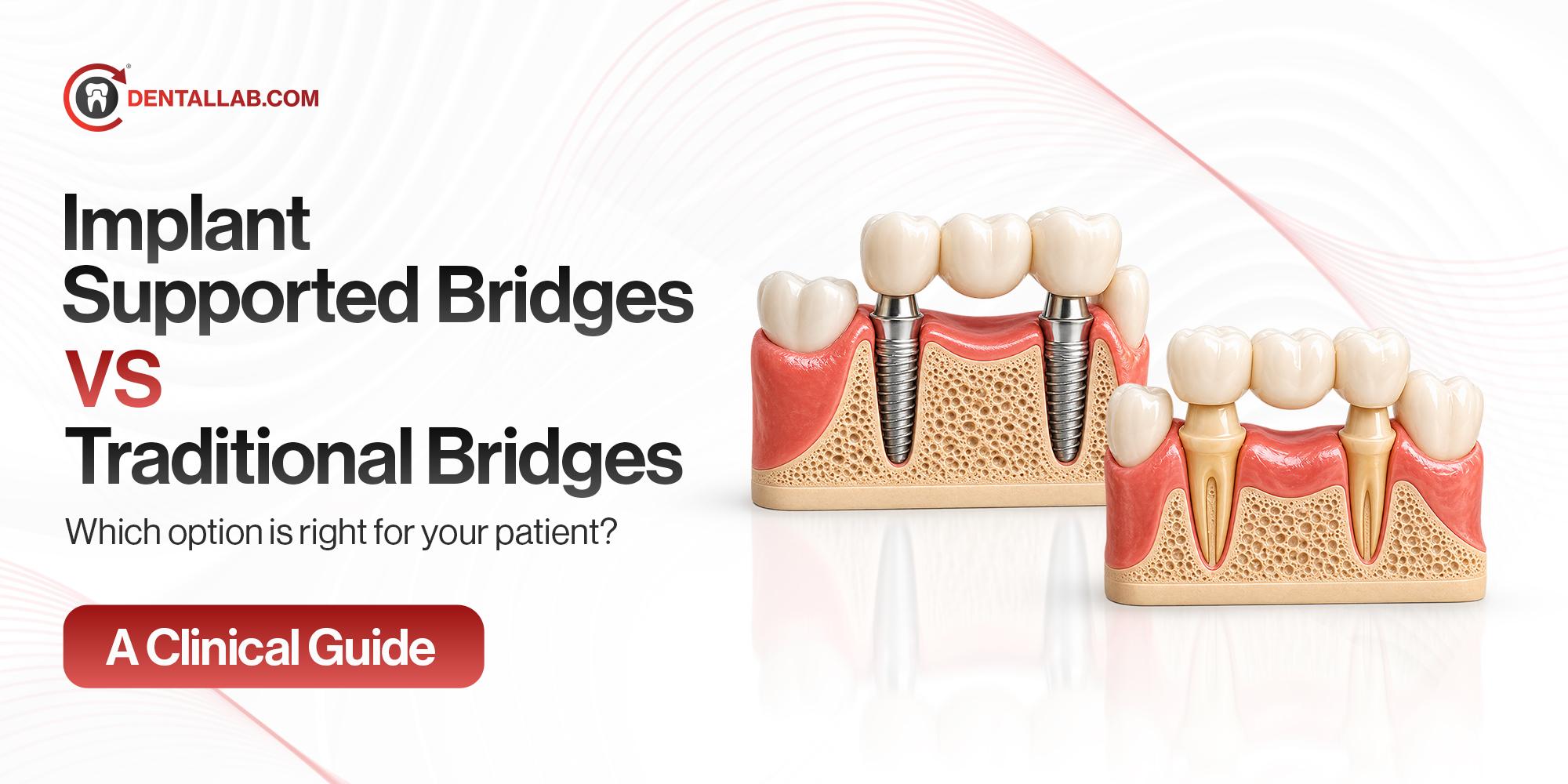
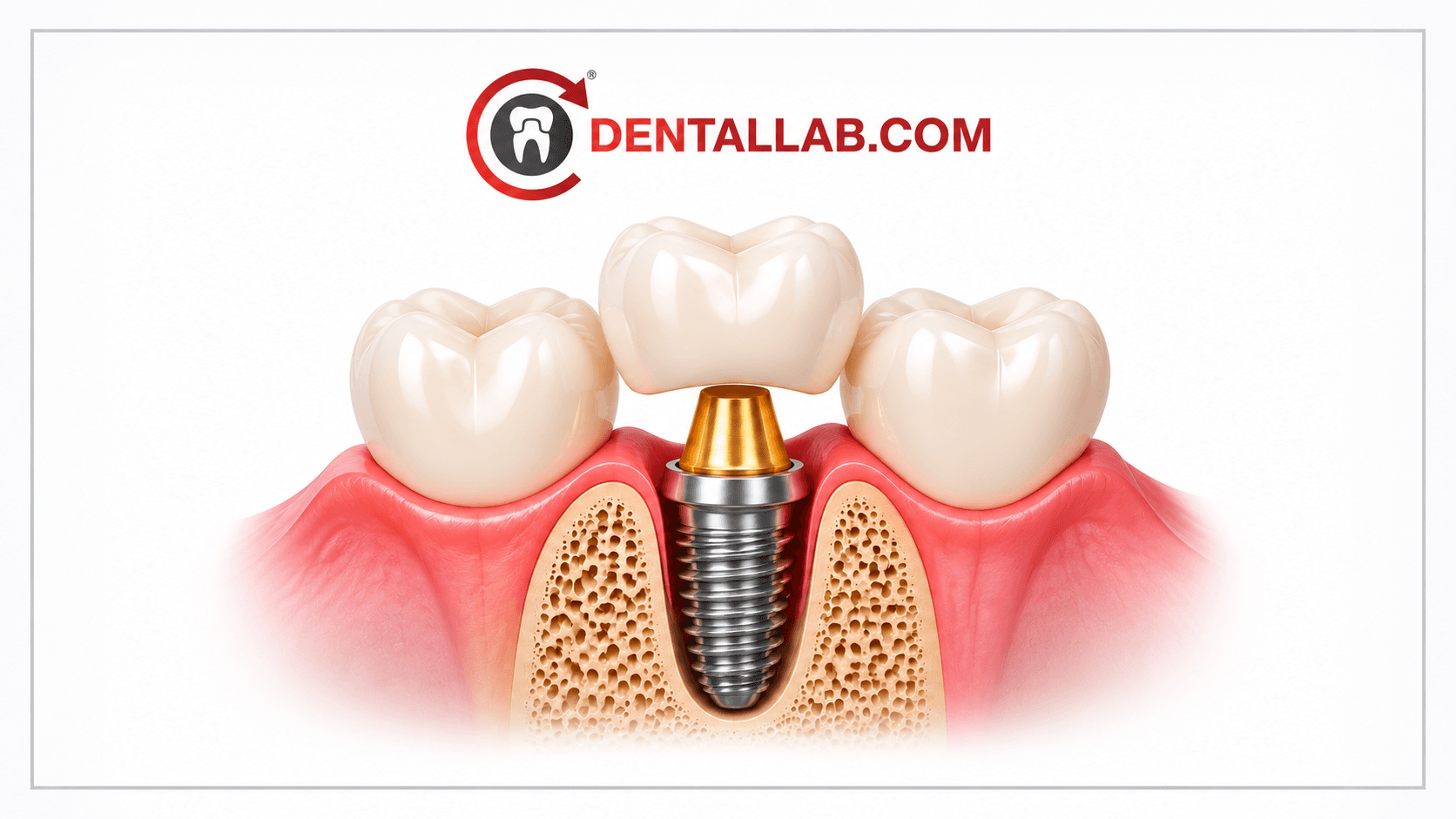
Two patients present with the same problem: two adjacent missing posterior teeth. One has healthy neighboring teeth and sufficient bone for implant placement. The other has extensively restored abutments and prefers to avoid surgery.
Both need a fixed restoration, but the most appropriate treatment may be different.
The decision between implant-supported bridges vs traditional bridges depends on more than the edentulous span. Dentists must evaluate abutment prognosis, available bone, occlusal loading, restorative materials, biological risks, treatment complexity, and long-term maintenance.
Implant-supported bridges preserve adjacent natural tooth structure, while traditional tooth-supported bridges can be appropriate when neighboring teeth already require crowns. Neither option is universally superior.
This comparison examines the clinical indications, treatment differences, complications, laboratory requirements, and costs that influence restorative planning.
Implant-Supported Bridges vs Traditional Bridges: Key Differences
Both restorations replace missing teeth using fixed prosthetic structures, but their support systems are fundamentally different.
How Traditional Bridges Work
Traditional fixed bridges use prepared natural teeth as abutments. Crowns or other appropriate retainers support the pontics that replace missing teeth.
Functional forces are transferred through the retainers to the supporting teeth and surrounding periodontal structures.
A conventional bridge may be particularly appropriate when the abutment teeth are already heavily restored and require new crowns.
However, abutment prognosis, periodontal support, crown-to-root considerations, occlusion, and the proposed span must be assessed before treatment.
How Implant-Supported Bridges Work
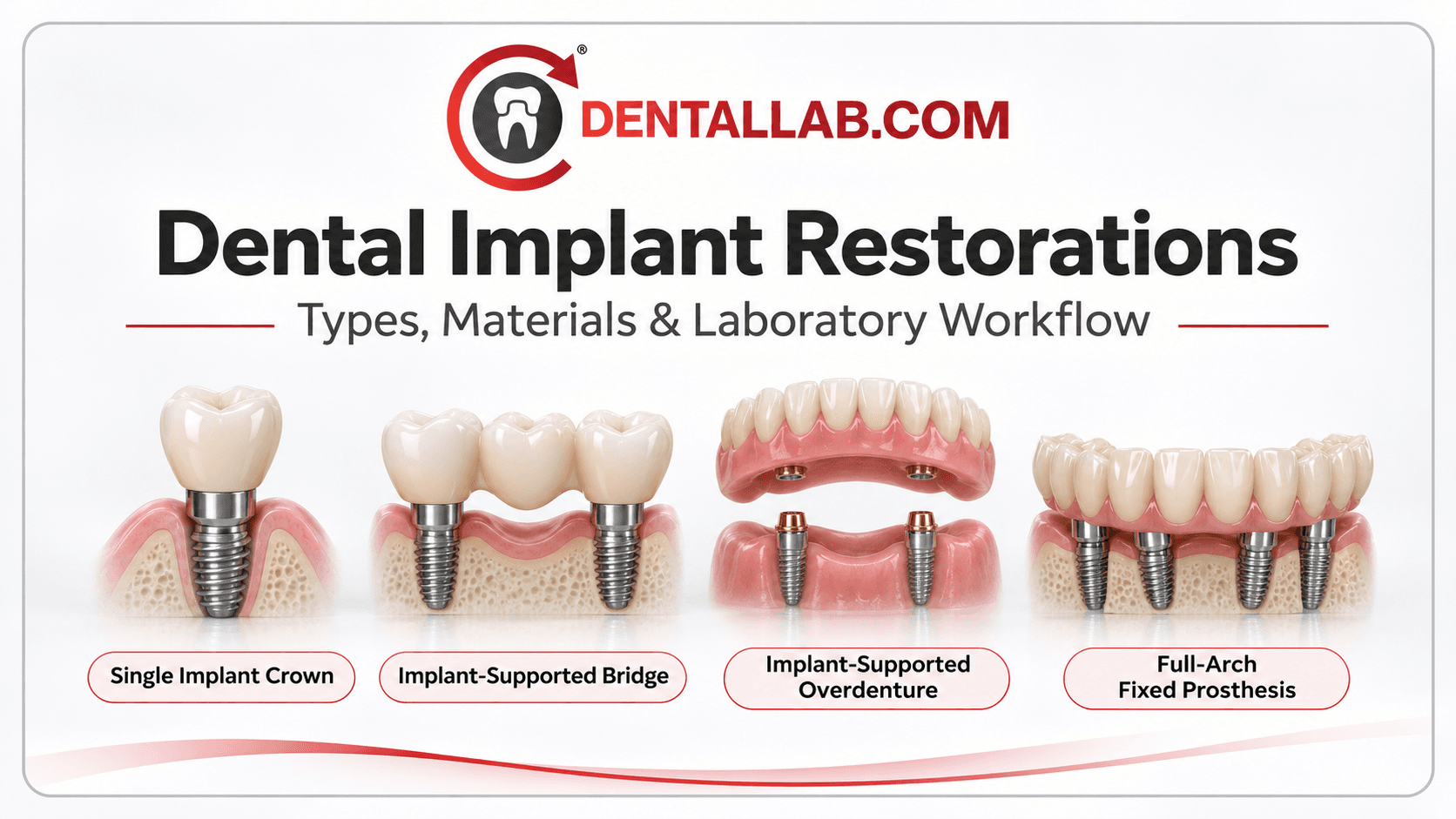
Implant-supported bridges use dental implants as prosthetic supports instead of relying on adjacent natural teeth.
The implants are positioned in the jawbone and connected to a prosthesis through compatible restorative components.
Depending on the case, the restoration may use screw-retained or cement-retained components.
Implant position, bone availability, restorative space, tissue contours, occlusion, and cleansability all influence prosthetic design.
7 Key Differences Between Implant-Supported and Traditional Bridges
Implant-supported bridges use dental implants, while traditional bridges rely on prepared natural teeth.
The following comparison summarizes the factors dentists commonly evaluate during treatment planning.
Clinical Factor
Traditional Bridge
Implant-Supported Bridge
Primary support
Natural abutment teeth
Dental implants
Adjacent tooth preparation
Usually required
Generally unnecessary
Surgical placement
Not required for the bridge
Implant surgery required
Bone requirements
Depends on tooth support and ridge condition
Adequate bone and implant positioning required
Treatment timeline
Often shorter when clinical conditions permit
May include healing, grafting, and staged procedures
Biological risks
Caries, pulpal and periodontal complications affecting abutments
Peri-implant disease and implant-related complications
Maintenance
Retainer margins, pontic hygiene and abutment monitoring
Peri-implant tissue care, prosthetic components and pontic hygiene
The relative advantages depend on the specific patient rather than the number of missing teeth alone.
When Is a Traditional Dental Bridge the Better Choice?
Traditional bridges remain important in modern restorative dentistry.
Their clinical value is especially apparent when existing conditions favor the use of natural teeth as supports.
Adjacent Teeth Already Require Crowns
When teeth bordering the edentulous space have extensive restorations or require full-coverage crowns, a conventional bridge may address multiple restorative needs within one treatment plan.
The condition of these teeth must still be evaluated carefully. Restoring an already compromised tooth does not automatically make it a suitable bridge abutment.
Dentallab’s fixed dental restorations include crowns and bridges fabricated in several restorative material categories.
Implant Surgery Is Not Appropriate or Desired
A tooth-supported bridge may be considered when implant placement presents significant clinical challenges or the patient declines surgery.
Medical history, medications, bone condition, periodontal status, and individual risk factors should be evaluated rather than treated as automatic contraindications.
For example, anticoagulant therapy or diabetes does not necessarily exclude implant treatment. The relevant risks and their management depend on the patient’s circumstances.
A Shorter Treatment Sequence Is Preferred
Traditional bridges may often be completed without the surgical and osseointegration stages associated with implant placement.
However, the final schedule depends on periodontal treatment, preparation requirements, provisionalization, laboratory production, and other clinical factors.
The practice should obtain a case-specific timeline instead of promising completion within a fixed number of weeks.
When Are Implant-Supported Bridges More Appropriate?
Implant-supported bridges can offer important advantages when preserving healthy neighboring teeth is a priority and the anatomical conditions support implant treatment.
Adjacent Natural Teeth Are Healthy
Preparing intact teeth for full-coverage bridge retainers may require unnecessary loss of tooth structure when implant-supported treatment is a viable alternative.
Implant support may allow the missing teeth to be restored without preparing those neighboring teeth.
This benefit must be weighed against surgical treatment, implant-related biological risks, and long-term prosthetic maintenance.
Natural Abutments Have an Uncertain Prognosis
A traditional bridge depends on the condition of the teeth supporting it.
Periodontal instability, recurrent caries, extensive structural damage, or unfavorable crown-to-root conditions may reduce the suitability of conventional abutments.
Implant support can sometimes provide a restorative option that does not depend on these compromised teeth.
However, successful implant placement still requires suitable anatomy and clinical risk assessment.
Longer or More Complex Edentulous Spans
Implants may provide alternative support configurations for longer spans where natural tooth-supported treatment is less appropriate.
The number and distribution of implants are determined by anatomy, prosthetic design, functional loading, available bone, and treatment objectives.
There is no universal rule requiring a fixed number of implants per missing tooth.
What Does the Clinical Evidence Say About Longevity?
Longevity is one of the most important considerations when comparing fixed tooth-supported and implant-supported restorations.
However, survival figures must be interpreted according to the restoration type, follow-up duration, complication definitions, and patient population.
A systematic review comparing three-unit fixed dental prostheses analyzed 1,973 tooth-supported and 765 implant-supported restorations. It found no statistically significant difference in prosthesis survival between the two groups, although aspects of tissue outcomes and patient-reported measures were incompletely reported.
This does not mean the two approaches have identical biological risks or maintenance requirements.
For dentists, the practical conclusion is that survival percentage alone should not determine treatment selection.
Traditional Bridge Complications
Potential biological and technical complications include:
Recurrent caries at retainer margins.
Periodontal deterioration of supporting teeth.
Pulpal complications.
Loss of retention.
Connector or framework fracture.
Chipping of veneering ceramics.
Inadequate cleaning beneath pontics.
Implant-Supported Bridge Complications
Potential complications include:
Peri-implant mucositis or peri-implantitis.
Implant or component complications.
Prosthetic screw loosening.
Framework or veneering ceramic fracture.
Difficult access for oral hygiene.
Problems related to residual cement in cement-retained designs.
Both treatment approaches require maintenance and ongoing clinical review.
Screw-Retained vs Cement-Retained Implant Bridges
Retention method is a separate prosthetic decision within implant-supported treatment.
Screw-Retained Restorations
Screw-retained bridges can be retrieved for maintenance or component repair, provided the design allows appropriate access.
They also avoid residual luting cement associated with certain cement-retained restorations.
However, screw-access position and angulation must be considered during restorative planning.
Cement-Retained Restorations
Cement-retained designs may be appropriate when screw-access position creates functional or esthetic limitations.
Abutment selection, margin accessibility, cement removal, and peri-implant tissue considerations are important.
Neither retention method should be selected without evaluating the complete prosthetic design.
Restorative Materials and Framework Design
Both tooth-supported and implant-supported bridges may use zirconia, metal-ceramic systems, or other appropriately indicated materials.
Material selection must account for span length, connector geometry, restorative clearance, occlusal loading, esthetic requirements, and manufacturing specifications.
Monolithic zirconia may reduce certain veneer-chipping complications associated with layered ceramics, while layered restorations may provide additional esthetic characterization.
The appropriate restoration is not determined by material strength alone.
Dentists should compare the specifications and clinical indications of available dental restorative materials before finalizing a prescription.
What Do Implant-Supported and Traditional Bridges Cost?
Cost comparisons should distinguish the patient’s total treatment cost from the laboratory fabrication fee.
Traditional Bridge Costs
Laboratory fees commonly depend on the number of units, selected material, framework design, and additional services.
The practice must also account for clinical preparation, provisional restorations, cementation, and potential future treatment affecting abutment teeth.
Implant-Supported Bridge Costs
Implant treatment may include surgical planning, implant placement, bone augmentation when indicated, prosthetic components, laboratory fabrication, and restoration delivery.
Laboratory charges may vary according to implant-system compatibility, abutments, framework materials, retention type, and design complexity.
The treatment may involve additional appointments or stages.
A lower initial fee does not necessarily result in lower long-term costs. Equally, a higher initial fee does not guarantee a more durable restoration.
Current treatment estimates and the laboratory’s fee schedule are more useful than generalized nationwide pricing claims.
What Does the Dental Laboratory Need for Each Bridge Type?
Digital case records, CAD/CAM design, prosthetic components, and fabrication of implant-supported bridges.
Laboratory communication differs depending on whether natural teeth or implants support the proposed restoration.
Traditional Bridge Case Requirements
A conventional bridge prescription should identify:
Supporting abutment teeth and pontic positions.
Preparation margins and available restorative space.
Selected material and framework design.
Pontic contour and ridge-contact requirements.
Accurate opposing records and bite registration.
Shade information and relevant photographs.
Important functional or parafunctional considerations.
Implant-Supported Bridge Case Requirements
An implant-supported bridge typically requires:
Implant manufacturer, system and platform information.
Accurate implant positions and compatible scan-body or impression records.
Complete soft-tissue and emergence-profile information.
Proposed screw-retained or cement-retained configuration.
Prosthetic component requirements.
Opposing arch and occlusal records.
Framework material, pontic design and shade information.
Verification or design-approval requirements where appropriate.
For implant-supported restorations, incomplete platform information or incompatible components can create avoidable delays.
The laboratory’s case submission workflow outlines digital file transfer and conventional case-submission options.
Making the Right Restorative Decision
Selecting between an implant-supported bridge and a traditional bridge requires a structured evaluation rather than a simple preference for one technique.
The most important questions include:
Are the adjacent natural teeth suitable abutments, or would their preparation sacrifice healthy tooth structure?
Is implant placement anatomically and medically appropriate?
What are the occlusal and prosthetic requirements of the proposed span?
Which biological and mechanical complications require long-term monitoring?
What treatment duration, costs, and maintenance responsibilities can the patient accept?
Does the chosen design provide appropriate hygiene access?
Can the prescribed restoration be manufactured and maintained using a compatible laboratory workflow?
An implant-supported bridge may better preserve intact adjacent teeth. A traditional bridge may offer advantages when suitable neighboring teeth already require extensive restoration or surgery is inappropriate.
The final treatment plan should reflect the individual patient’s clinical condition and preferences.
Final Thoughts
Implant-supported and traditional bridges are established fixed restorative options, but their indications and maintenance requirements differ.
Implant support can avoid preparation of healthy neighboring teeth and provide additional prosthetic options for selected edentulous spans.
Traditional bridges remain valuable where suitable natural abutments already require restorative treatment or when a non-surgical approach is preferred.
In either case, careful diagnosis, material selection, accurate records, and clear communication with the dental laboratory support predictable restorative care.
Dentallab.com works with dental practices across the United States to support fixed and implant-related restorative workflows.
Try your first case with us and get $150 OFF. Claim your credit at Dentallab.com.
Frequently Asked Questions
What is the difference between implant-supported bridges and traditional bridges?
Implant-supported bridges rely on dental implants, while traditional bridges use natural teeth as abutments. Their preparation requirements, biological risks, and maintenance needs differ.
Are implant-supported bridges better than traditional bridges?
Not universally. Implant-supported bridges may better preserve healthy adjacent teeth, while traditional bridges can be appropriate when suitable neighboring teeth already need crowns.
How long do implant-supported bridges last?
Longevity varies according to implant health, prosthetic design, material, hygiene, and maintenance. Survival statistics should be interpreted using the specific restoration type and study follow-up period.
How many implants are needed to support a dental bridge?
The number depends on the edentulous span, bone availability, implant distribution, occlusion, and planned prosthesis. There is no universal implant-to-tooth ratio.
Are traditional bridges faster than implant-supported bridges?
They may require a shorter overall treatment sequence when the supporting teeth are ready for restoration. Implant treatment may include surgery, healing, and additional procedures. Timelines must be assessed individually.
Do implant-supported bridges get cavities?
The prosthetic materials do not develop dental caries, but implant-supported bridges remain susceptible to biological and technical complications, including peri-implant disease.
Should an implant bridge be screw-retained or cement-retained?
The decision depends on screw-access location, retrievability, implant angulation, abutment selection, and tissue considerations. Both approaches have appropriate clinical applications.
How much does an implant-supported bridge cost from a lab?
Laboratory fees depend on the number of units, implant components, framework material, retention system, and fabrication complexity. An accurate quote requires the laboratory’s current fee schedule and case specifications.
What information does a dental lab need for an implant-supported bridge?
The laboratory needs implant-system and platform details, accurate records, prosthetic component requirements, occlusal information, retention preferences, material selection, and relevant clinical photographs.